Incorporating absolute sustainability in EU policy
How can absolute sustainability become part of EU policy?
Research can drive real change when it informs decision-making. But what does it take to translate absolute sustainability from theory and academic findings into policy?
Join us as the DTU Centre for Absolute Sustainability’s Lunch Seminars return with “Incorporating Absolute Sustainability in EU policy” where we will explore how planetary boundaries and life cycle assessment can be incorporated into EU policy to support the transition towards truly sustainable societies.
📅 20 August 2026
🕓 12.00-13.00 CEST
📌 At DTU or virtual
🎟️ Participation is free and open to everyone
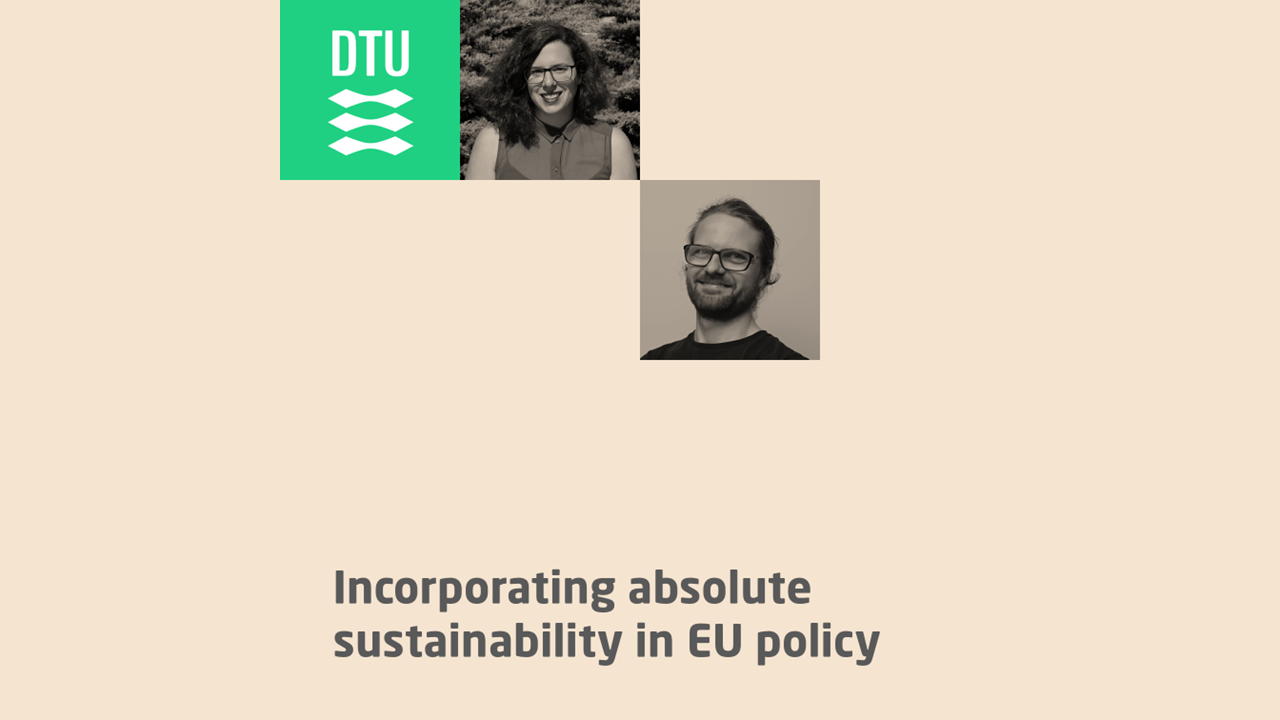
At the seminar, you will meet:
Esther Sanyé-Mengual: environmental scientist at the Sustainable Supply Chains and Bioeconomy Unit of the Joint Research Centre of the European Commission, providing science-based support for policy-making. Esther focuses on life cycle thinking-based methods, tools and data, with expertise on the Environmental Footprint methods, life cycle impact assessment, consumption footprint, absolute sustainability with planetary boundaries, and the assessment of clean transitions.
Anders Bjørn: associate professor at DTU Sustain and the Centre for Absolute Sustainability. His research focuses on developing and assessing methods to measure environmental burdens of companies and other stakeholders against planetary boundaries, and on setting corresponding impact reduction targets. Anders also works on translating ethical principles for allocating scarce resources into environmental burden allowances for specific stakeholders.